
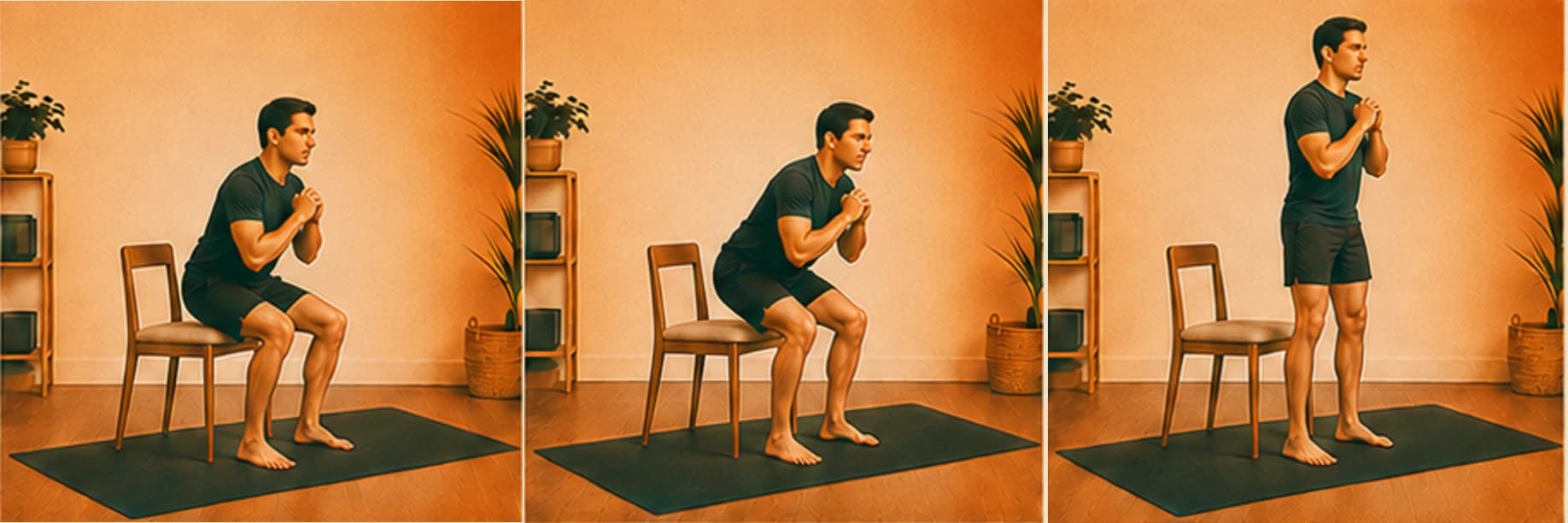
Execution
How to do it
- 01
Place a stable chair behind you, feet slightly wider than your hips and flat on the floor.
- 02
Brace your abs and keep your chest up.
- 03
Push your hips back, then lower yourself until you sit down gently, knees in line with your feet.
- 04
Stand up by pushing through your feet, without using your hands if you can.
Dropping onto the chair: keep the descent controlled.
The chair serves as a depth marker and support. Sources: ACE — Bodyweight Squat. These cues do not replace a professional if you have pain or are in rehabilitation.
The decision
When this movement makes sense
Touching the seat gives a concrete range-of-motion marker for a first calibration or an easier variant.
A light, rolling or unstable chair does not provide that marker: the name of the object does not guarantee the configuration.
Real requirements
Configurations kept genuinely separate
Bodyweight
8–15 repetitions- Equipment
- Bodyweight
- Supports and space
- a stable seat
- Setup
- 25 s
- Planned work
- 45 s
- Planned rest
- 75 s
- Planned sets
- 1–3
- Complete budget
- 90–330 s