
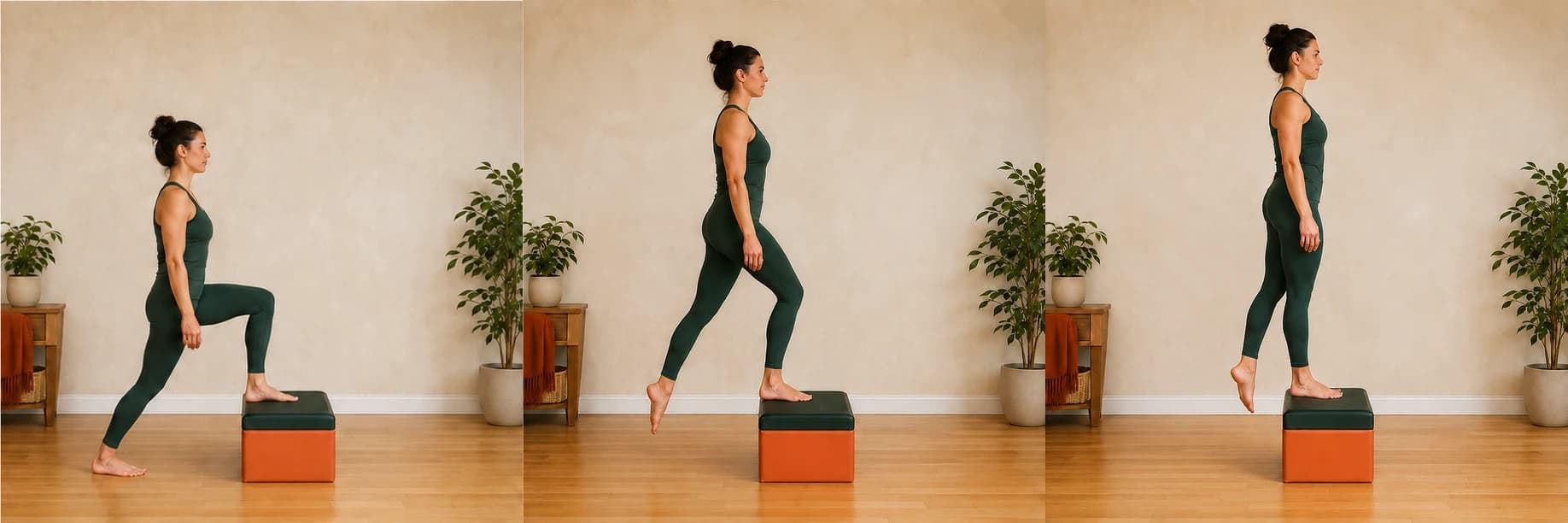
Execution
How to do it
- 01
Face a low step designed to bear the exercise, feet hip-width apart.
- 02
Place your whole foot on the step, knee in line with your foot, torso upright.
- 03
Step up by shifting your weight onto the leg on the step, then bring the other foot alongside.
- 04
Step down leading with the back foot, without jolting. Switch the leading leg.
Letting your knee cave inward as you step up.
Bodyweight on a low step rather than with dumbbells on a platform. Sources: ACE — Step-up. These cues do not replace a professional if you have pain or are in rehabilitation.
The decision
When this movement makes sense
It uses a concrete height marker and work per side, but must not turn household furniture into default equipment.
Without a dedicated step or a genuinely stable support, the split squat or the sit-to-stand provides a more verifiable constraint.
Real requirements
Configurations kept genuinely separate
Bodyweight
6–12 repetitions- Equipment
- Bodyweight
- Supports and space
- a low step designed to bear exercise load
- Setup
- 55 s
- Planned work
- 70 s
- Planned rest
- 90 s
- Planned sets
- 1–3
- Complete budget
- 155–475 s