
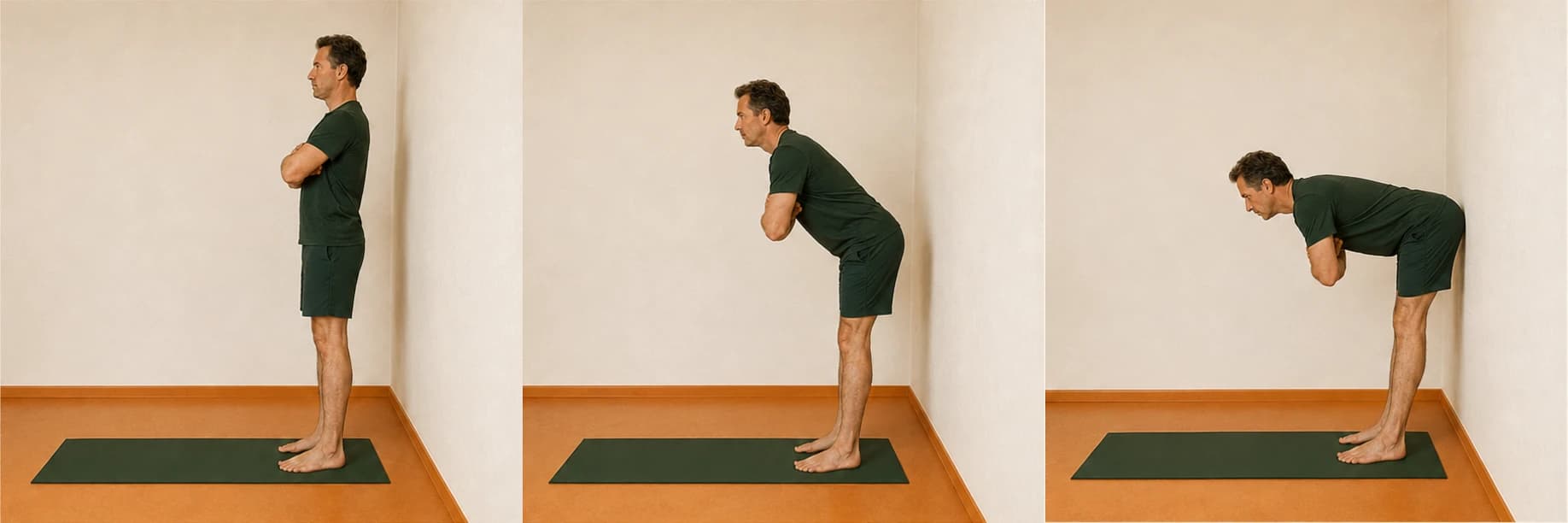
Execution
How to do it
- 01
Stand with your back to a wall, about one foot-length away, feet shoulder-width apart and knees slightly bent.
- 02
Shift your weight onto your heels, then push your hips back toward the wall as your torso leans forward.
- 03
Keep your back flat: head, upper back and lower back stay in line.
- 04
Go down until your torso is halfway between upright and horizontal, then return by squeezing your glutes and driving your hips forward.
Bending your knees as in a squat instead of pushing your hips back.
The wall is the target for your hips; the source also uses a bar along the back. Sources: ACE — Hip Hinge. These cues do not replace a professional if you have pain or are in rehabilitation.
The decision
When this movement makes sense
It provides a first hinge variant with a short setup and an explicit spatial marker.
That marker does not prove that load can already be added: the Romanian deadlift remains a different progress context.
Real requirements
Configurations kept genuinely separate
Bodyweight
8–15 repetitions- Equipment
- Bodyweight
- Supports and space
- a wall or stable vertical surface
- Setup
- 25 s
- Planned work
- 40 s
- Planned rest
- 60 s
- Planned sets
- 1–3
- Complete budget
- 85–285 s