
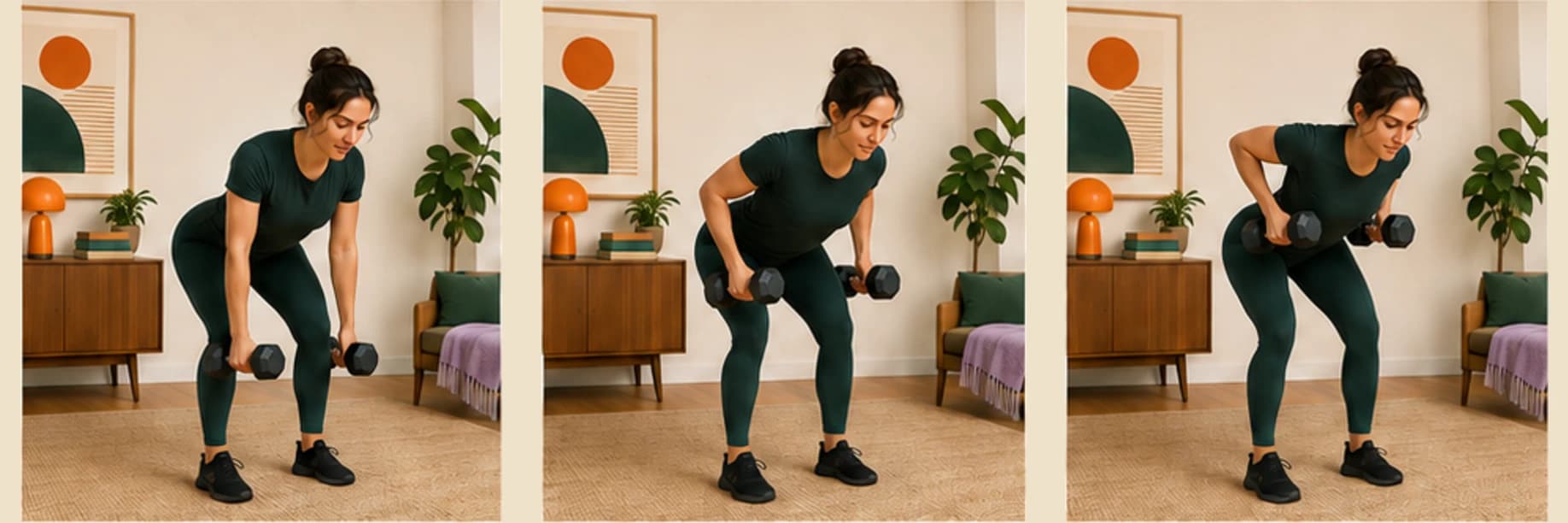
Execution
How to do it
- 01
A dumbbell in each hand, knees slightly bent, lean forward from your hips with a flat back.
- 02
Let your arms hang straight under your shoulders.
- 03
Pull the dumbbells toward your belly button, keeping your back flat.
- 04
Lower slowly until your arms are straight.
Common mistake
Rounding your back or standing up on every rep.
Two dumbbells rather than a barbell. Sources: ACE — Bent-over Row. These cues do not replace a professional if you have pain or are in rehabilitation.
The decision
When this movement makes sense
It covers a two-arm horizontal pull when the pair is available and the variant has already been calibrated in this context.
When this changes
With a single dumbbell, or when support is preferable, the supported one-arm row is a different decision, not a simple duplicate.
Real requirements
Configurations kept genuinely separate
Two matching fixed dumbbells
8–12 repetitions- Equipment
- Two matching fixed dumbbells
- Supports and space
- No additional support declared
- Setup
- 45 s
- Planned work
- 45 s
- Planned rest
- 90 s
- Planned sets
- 1–3
- Complete budget
- 115–385 s
Two adjustable dumbbells
8–12 repetitions- Equipment
- Two adjustable dumbbells
- Supports and space
- No additional support declared
- Setup
- 60 s
- Planned work
- 45 s
- Planned rest
- 90 s
- Planned sets
- 1–3
- Complete budget
- 135–405 s