
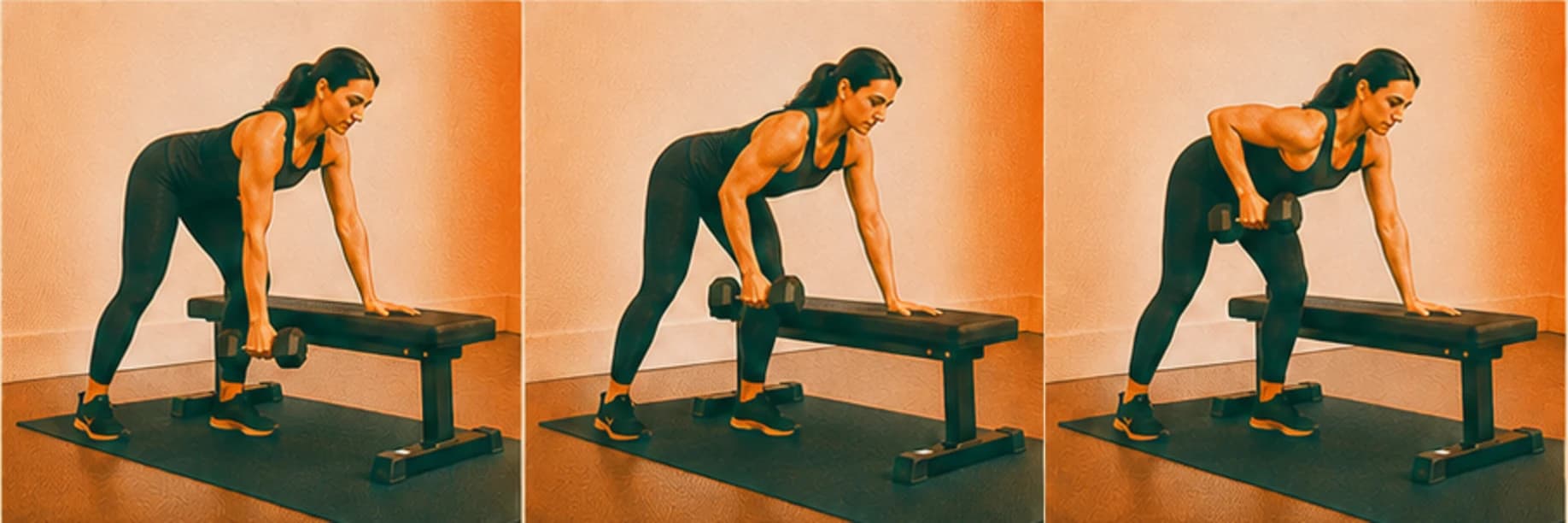
Execution
How to do it
- 01
Place your free hand on a stable support, torso leaning forward, back flat; the dumbbell hangs with the arm straight under the shoulder.
- 02
Brace your abs, keep your head in line with your back, shoulders down and back.
- 03
Pull the dumbbell up by bending your elbow, arm close to your body.
- 04
Stop before your torso rotates, then lower slowly. Repeat on the other side.
Rotating your torso to lift the dumbbell higher.
Standing with a hand support rather than a hand and knee on a bench. Sources: ACE — Single-Arm Row. These cues do not replace a professional if you have pain or are in rehabilitation.
The decision
When this movement makes sense
It provides a horizontal pull with little equipment, but its cost has to count both sides and setting up the support.
Without a stable support, the engine does not relabel it as a bent-over row: that movement has its own posture demands and selection.
Real requirements
Configurations kept genuinely separate
One fixed dumbbell
8–12 repetitions- Equipment
- One fixed dumbbell
- Supports and space
- a stable hand support
- Setup
- 50 s
- Planned work
- 70 s
- Planned rest
- 90 s
- Planned sets
- 1–3
- Complete budget
- 150–470 s
One adjustable dumbbell
8–12 repetitions- Equipment
- One adjustable dumbbell
- Supports and space
- a stable hand support
- Setup
- 65 s
- Planned work
- 70 s
- Planned rest
- 90 s
- Planned sets
- 1–3
- Complete budget
- 170–490 s
One kettlebell
8–12 repetitions- Equipment
- One kettlebell
- Supports and space
- a stable hand support
- Setup
- 50 s
- Planned work
- 70 s
- Planned rest
- 90 s
- Planned sets
- 1–3
- Complete budget
- 150–470 s